research
research
Moving Image as Inquiry
2026
What might it mean to approach moving image not as representation, but as a mode of being with?
My practice research engages cinema as a methodological orientation—an embodied and relational way of sensing, composing, and remaining within situations rather than extracting from them. This orientation emerges through ongoing work in critical and collective fabulation, where story-making is not treated as narrative construction but as an entangled, processual practice of relation.
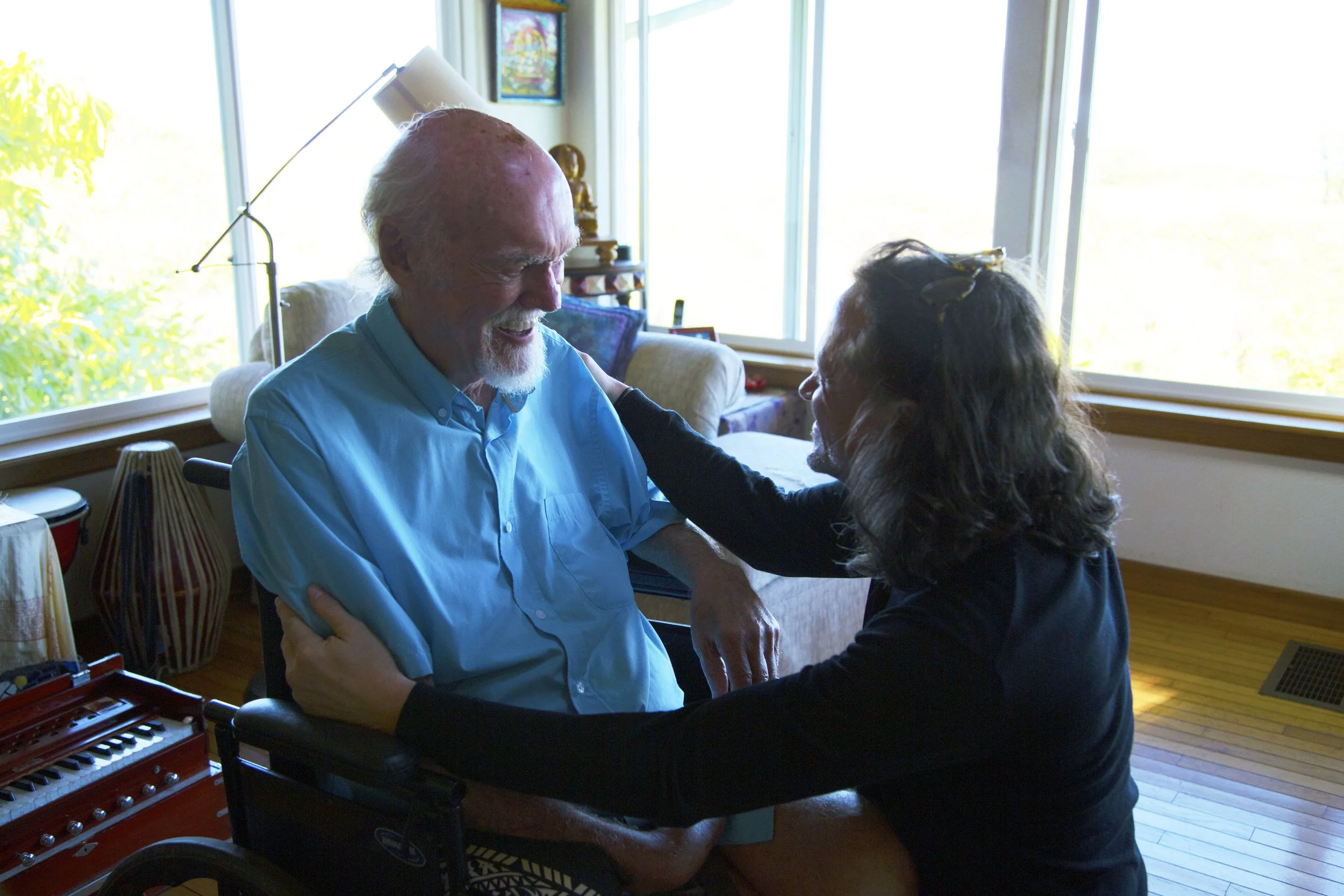
End of Life (2017), developed over six years in collaboration with five individuals, unfolded through sustained, durational engagement. The work did not proceed through predetermined structure or explanatory intent, but through a commitment to remaining with—attending to bodies, environments, and the uneven temporalities of lived experience as they emerged.
Within this process, filmmaking operated less as a means of capturing what was already there than as a way of participating in the formation of relationships. The camera became an extension of the sensing body—a practice I describe as drawing with the camera: a choreography of movements in and through particular situations that privileges proximity, reciprocity, and partial perspective. What comes into view, what remains withheld, and what is felt but not seen all participate in a relational field that resists stabilization.
This approach unsettles conventional distinctions between observation and composition. Situations are not documented and later interpreted; they are composed and inhabited as the research itself. Duration, silence, gesture, and improvisation function not as aesthetic choices alone, but as methodological conditions through which knowledge takes form.
Narrative, in this context, does not organize experience toward coherence. Instead, it emerges through fragmentation, repetition, and openness—allowing for forms of sense-making that remain incomplete and situated. Moving image here operates alongside but differently from textual or analytic inquiry, sustaining forms of attention that exceed explanation.
By formalizing End of Life as a research object (Bruce & Wojtasik, 2017), the work enters into a different mode of circulation—one that allows it to be cited, referenced, and encountered within scholarly discourse (https://doi.org/10.5281/zenodo.19422679). Yet its primary operation remains experiential and relational. The question is not how to translate film into text, but how to recognize moving image as a site where inquiry takes place through encounter.
This reflection does not attempt to define a general framework, but to remain with one instance of practice as a way of approaching a broader question: how moving image might function as a method for composing relations, attending to what emerges, and engaging the world without reducing it to what can be known in advance.
This work emerges alongside ongoing inquiries into critcal and collective fabulation and the latent archive, where moving-image practices engage processes of rereading, recirculation, and relational becoming.
Archiving as Return
2026
What becomes of the moving images that never quite become films?
Across more than four decades of practice I have accumulated hundreds of hours of moving-image material in Super 8, 16mm, one-inch video, Hi-8, BetaCam, MiniDV, PixelVision, and digital formats. Some fragments found their way into films, installations, or performances. Many did not. They remain on reels, tapes, hard drives, and contact sheets—not simply unused, but continuing to change their relation to the circumstances in which they were recorded.
I have begun to think of these materials as a latent archive.
This archive is not defined by incompletion alone. Nor is it a reserve of material waiting to become future work. Many fragments may never appear publicly. Others return years later, transformed less by editing than by time itself. Relationships shift. Collaborators die. Technologies disappear. Places become inaccessible. The image remains materially the same while the conditions through which it can be encountered have fundamentally changed.
One sequence has returned to me repeatedly.
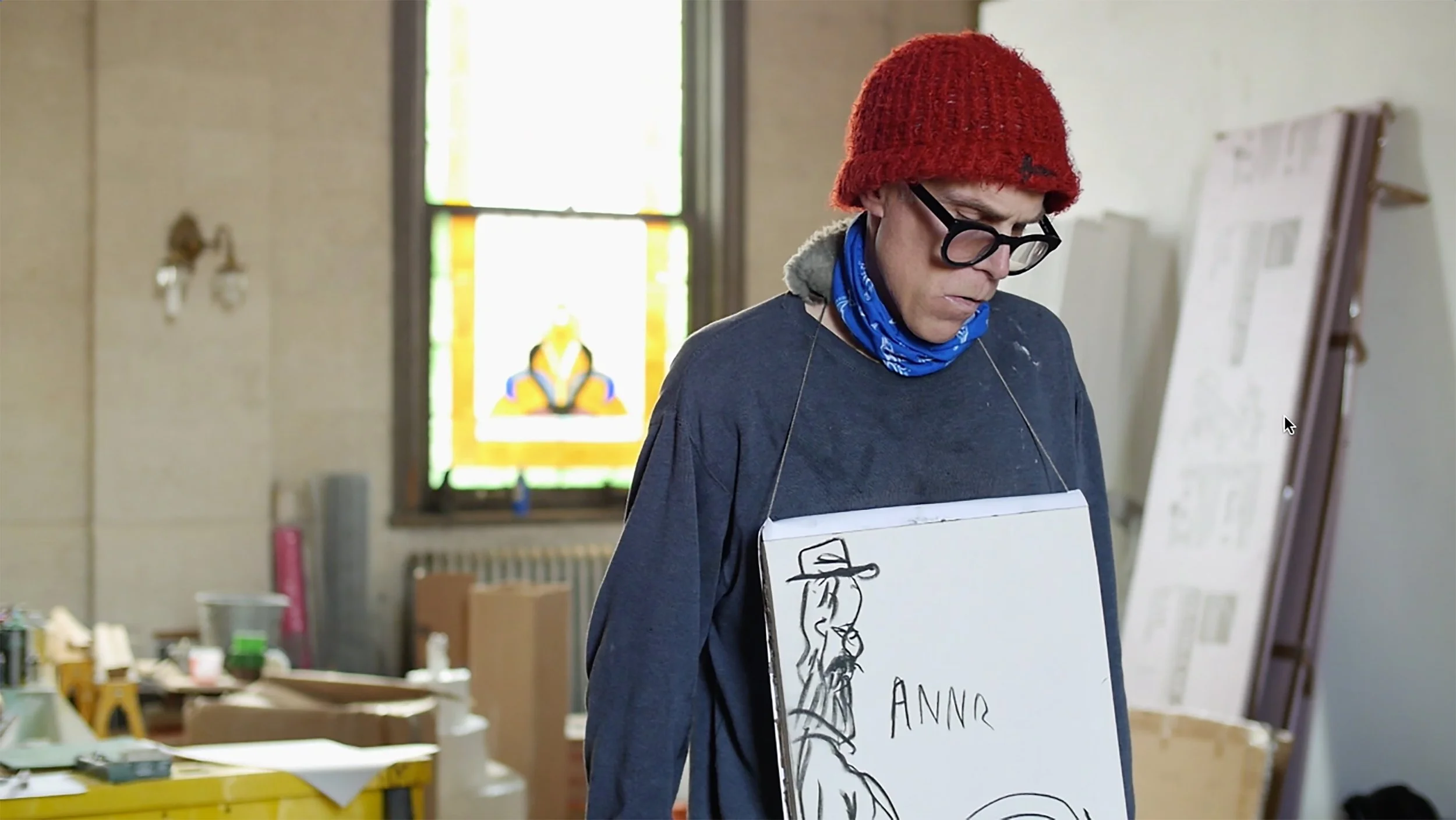
While filming End of Life, artist Matt Freedman began describing Adolfo Bioy Casares's novel The Invention of Morel. His account unfolded as a rehearsal rather than an interview: a remembered story becoming performance while I filmed. At the time, I had no sense that this fragment would become central to the project. It remained among many other recordings.
Years later, returning to the footage, something had shifted. What first appeared as documentation had become something else. Freedman's rehearsal became the basis for a new scene: a reenactment of The Invention of Morel, staged not as an illustration of the novel but as a way of inhabiting its peculiar temporal logic. The resulting sequence entered End of Life. Since then, it has returned again, becoming part of my ongoing research into archival latency.
Nothing about the original recording anticipated these later lives. The fragment was never simply retrieved. Each return altered the conditions through which it could be encountered. The image accumulated rather than resolved.
This differs from thinking of an archive as a repository from which material is selected and repurposed. Something happens in the interval. The fragment recorded fifteen years ago is not the fragment encountered today, even when the sequence of frames is unchanged. Time does not simply pass around images. It gathers within them.
Latent archive is the term I use to approach this condition. Latency does not describe material waiting passively for future activation. It describes moving-image traces that remain unfinished enough to enter new relations across time. Some will become films. Some will reappear unexpectedly within other works. Others may remain dormant for decades, or never emerge at all. Their incompletion is not a deficiency. It is part of what they carry.
This understanding of the archive extends my ongoing inquiry into moving image as a methodological practice. If filmmaking can operate as a way of composing relations rather than representing them, then the archive also becomes relational—not a fixed repository of the past but an evolving field in which images continue to acquire new temporal, material, and ethical significance through return.